|
|
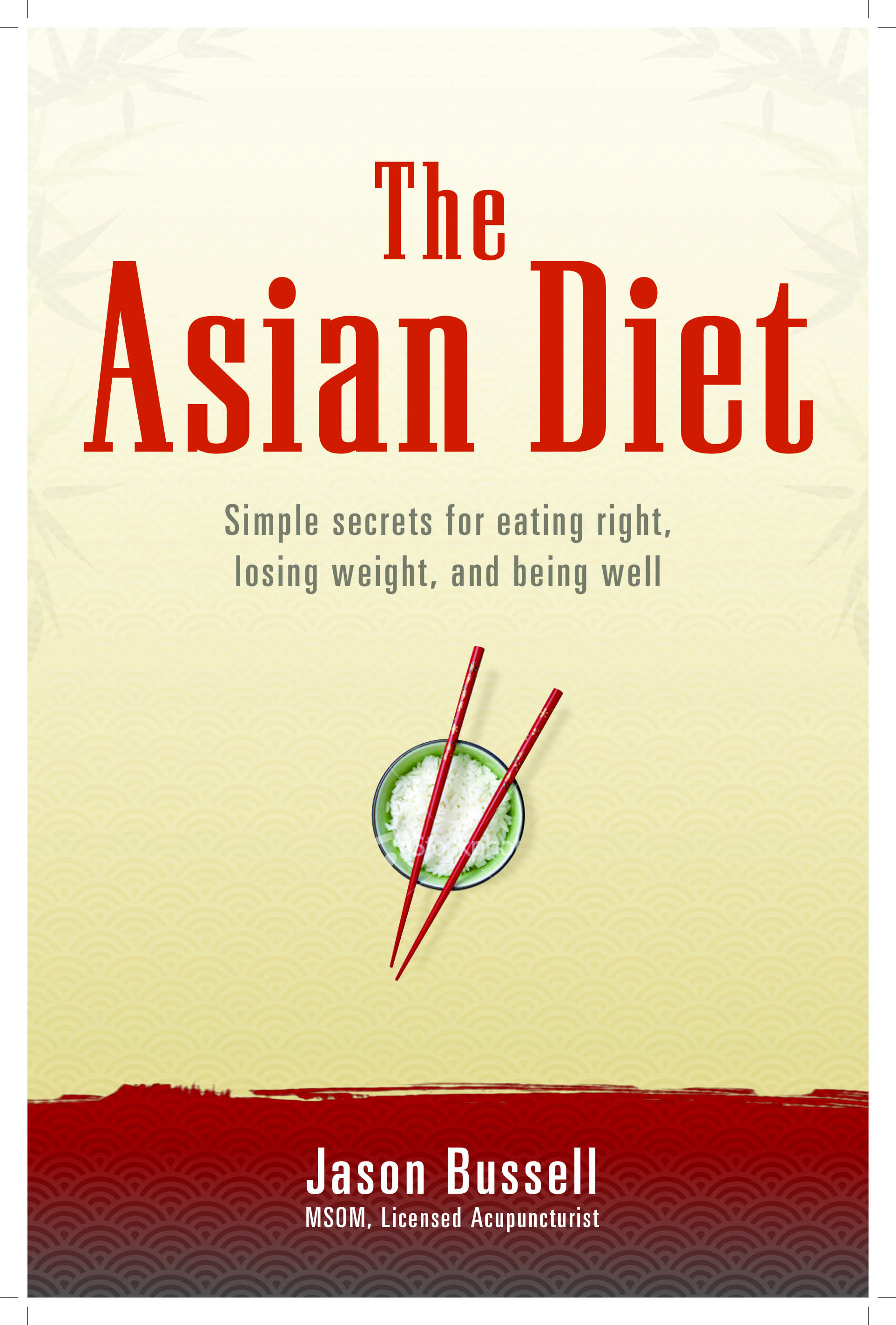
The Asian Diet: Simple secrets for eating right, losing weight, and being well by Jason Bussell
MSOM, Licensed Acupuncturist |
|||
Home |
If the information in this book has helped you in any way, we'd love to hear about it. Please send your story to Jason@theasiandiet.com
The Asian Diet has been named a Top Diet by US News and
World Report
Every year, US News and World Report ranks the best
diets. In 2013, The Asian Diet made it on the list. They refer to it
as the “Traditional Asian Diet” because there is not just one specific
Asian Diet and because the diet is Asia is changing lately as the
Western diet is creeping into their culture (with disastrous effects).
But my book, The Asian Diet: Simple secrets for eating right, losing
weight, and being well, was a main source that US News and World
Report consulted in evaluating the Traditional Asian Diet. 22 experts
evaluated 29 different diets. Read the whole article here at
http://health.usnews.com/best-diet . Here’s what they had to say
about the Asian Diet.
Overall, this diet plan was ranked at #11, but came in 4th
among plant-based diets. One reviewer wrote “the nutritional balance is
better than most other plant-based or vegan diets”. Some of the
negative aspects the reviewers pointed out reflect their interpretation
of the traditional Asian diet and do not reflect the Asian Diet as it is
explained in my book. I will discuss them later.
Will it help you lose weight?
Probably. Research suggests people in Asian countries who follow this
dietary pattern weigh less than their Western counterparts. That’s
likely because it’s high in healthy foods that keep hunger at bay: whole
grains, vegetables, and bean products, for example.
Is it good for cardiovascular health?
It’s likely. Asian diets are low in fat, especially the saturated
variety, and high in fiber, due to an emphasis on fruits and veggies,
whole grains, and rice. And they’re in line with the medical community’s
widely accepted definition of a heart-healthy diet that keeps
cholesterol and blood pressure in check and heart disease at bay.
Is it good for prevention or control of diabetes?
The diet appears to be a viable option for both. Studies have shown
that this type of diet can improve glucose tolerance as well.
Is it safe? The experts
found no possible harmful effects of following this diet plan.
Is it nutritious?
Absolutely. Following the Asian Diet, you should have no trouble
staying within the recommended amounts for: Fat, protein,
carbohydrates, salt, fiber, potassium, calcium, vitamin B-12, and
vitamin D. No supplementation is necessary when following the Asian
Diet.
Is it easy to follow? The
authors said that if you don’t like rice, noodles, legumes, and
vegetables, then it may be hard. But, it is hard to be healthy if you
are avoiding vegetables. We don’t just feed our tongues, so one of the
things we need to do in order to improve our health is to increase the
variety of foods that we eat. If you don’t like vegetables, suck it up
and eat some anyway.
Will I be hungry? No. With
so many fiber packed foods, and with no calorie cap, you shouldn’t go
hungry.
New review sent in by the editors of a website The Asian Diet is a straight-to-the-point and reliable book about dieting and weight loss. The problem of obesity in America is worsening to a point where a quarter of the adult population is medically obese. The book tells us that there is a historically proven eating habit that can remedy the problem. If we were to point out a flaw in the book, it would be the title. There is a preponderance to fall back to Chinese Cuisine. Not that we're complaining. The Chinese culture has the oldest continuous record of food recipes and faithfully handed down the generations. The book also mentions Traditional Chinese Medicine, which to the Western culture boils down to tea drinking and acupuncture. There's a lot more. On our side of the spectrum, cosmetic surgery presents a quick and largely cosmetic solution to obesity. Bariatric and lapband surgeries are dangerous and presents a lifestyle that is extremely difficult to maintain. Get the copy of the book now before it's too late! - www.tummytuckcost.com
Excerpts from an email received 12/2/2010
"I have just completed* The Asian Diet and wanted to tell
you that, in my opinion, this is one of the most important books I have
ever read in my 76 years, I use the word "completed" because I believe
it was just that - a course of study and understanding of the principles
you present....As a survivor of five (5) types of cancer (it runs in my
family on both sides) and a long-time diabetic with A1C readings usually
around 5.4, I have always tried to surround myself with positive energy
and maintain good eating habits...As an avid fan of Asian cooking, I am
absolutely delighted to know that my penchant for Japanese noodles and
white rice can once again be on my grocery list. ... I am so glad you
included the section on green tea in your book, because I started
drinking at least 6 to 8, 8-oz. glasses each day since in my early 30's,
when I had my first encounter with cancer. I love the ritual of loose
leaf tea. Since reading (and rereading) your book, I have lost a total
of seven pounds...I just wanted to take this opportunity to thank you
for such a marvelous book. I am a native of Chicago and only wish I had
had knowledge of you before I moved.
Most Sincerely, Susan V" (full name withheld)
Laura Cone, a writer for Yahoo!
Associated Content gives The Asian Diet 4.9 out of 5 stars. Read the
review
here Why We Must Override Our Natural Instincts
|


| By | Sun Wind Pinon
"earthmom" (USA) -
|
I bought this book for someone else but one peek inside and I was
hooked. Read it cover to cover and am keeping it to refer to. (yes, I had
to buy another for my friend!) What a wonderful book.
The information is clear, common sense, gently put across, and not
complicated. It rang very clear and positive for me and has helped me to
make some important changes in a diet that I thought was pretty good but
now see very logical flaws.
Thank you Jason Bussell! This one is a treasure.
"Enjoyable Read!" A review by internet journalist Graeme Thompson
A weight loss book that doesn't offer to change
your life in a month? Seriously? In America?
What I liked most about this book is that it takes the long view. The
point is to bring your life into balance by changing your lifestyle
generally, including diet and attitude. It doesn't offer quick fixes, and
Mr. Bussell repeatedly reminds the reader there isn't really any such
thing.
Indeed, it's quite possible to read this book as cultural criticism. Why
does dairy have so much power in the US? Why do we eat so much meat? Why
are we the single culture that loves to ice our drinks?
Money drives much of our culture. There is money to be made in creating
problems. Then money is made with promises to fix the problems. Many of
the book's better points are made when the author looks at American
culture through the lens of Chinese thinking. You don't have to be
interested in weight loss to find the conclusions compelling.
Essentially, America is a young nation, and our culture is based on young
ideas. We're excited by excess, and we're continually reeling from one new
trend to the next, while older countries look on: sometimes in amusement,
sometimes in horror.
What does this have to do with why you're fat? The author asks that you
give the question some honest thought. Think about the typical commercial
for an antacid that promises you can continue to eat fried food because
their product blocks the pain signals your body is sending you. Isn't that
typically American to be told, "You shouldn't adapt your diet! Why take
care of yourself when you can have more french fries!?"
Does that really make sense to you? It may *appeal* to you, but is it
advice you'd give someone you care about?
The book is written in a conversational style that's pleasant. There are
instructions, of course, but the author doesn't nag. Instead, we're
reminded to take the long view of everything, including diet. Dump the
microwave and the fast food, and take control of your life by relaxing,
getting enough sleep, and eating real food.
Bussell encourages making small changes for the better now, because even
if you backslide, over time your progress will snowball into a better
quality of life. It's nice to hear that relaxed, longer time-horizon
message. It's a calming counterpoint to a culture that pushes the new and
the now. Perfection, if it comes, is never quick. Relax, get in balance,
and develop healthier habits. Weight loss will follow in time. If this
sounds interesting to you, then buy this book.
Sensible, plainspoken advice - A review by Lucas Davenport, New Orleans La.
In an age where we are inundated by quick fixes and short term solutions, Mr. Bussell gives us the long view for health and good dietary habits. This book shouldn't be mistaken for a cookbook, its more like a bible of good habits. Mr. Bussell sets a simple outline of habits (both good and bad) and then explains in a conversational tone which habits those seeking true health should employ. Though it contains some advice that americans may find anathema (NO DAIRY?!), their rationales are clearly explained and explored. This is about more than good food for your body, its about good food for your mind.
From Positive Health Online
In this era of fad diets, detox programmes, and 'superfoods', this
examination of the relationship between diet and lifestyle looks to the
Far East and claims that the simple principles to live by are balance and
moderation. The diet outlined in this book teaches the daily effects that
particular food choices will have-on bodyweight, energy, mood, and the
quality and duration of life. All major food groups are covered, with
additional sections on dietary supplements, lifestyle, and attitude.
What Makes this Book Special?
The information within The Asian Diet is a compilation of the
information Bussell tries to impart to all his patients. It is filled with
advice on how to change your diet, lifestyle and attitudes to improve your
health, vitality and longevity.
What are the benefits of buying this book?
- Learn how your food choices affect the functioning of your body and mind
- Learn how to make proper food choices
- Learn how to adjust your lifestyle and attitudes to promote health and well-being
About the Author
Jason Bussell has a Master of Science Degree in Oriental Medicine; he
is nationally board certified in Acupuncture and Oriental Medicine, the
President of the Illinois Association of Acupuncture and Oriental Medicine
and is on the Advisory board for curriculum development of the Pacific
College of Oriental Medicine. Bussell has published articles in
professional journals.
From That'sFit.com, written by Mary Kearl

Jason Bussell, author of "The Asian Diet"

That's Fit: Can you describe how one can transition from an "American" diet to an "Asian" diet?
Bussell: The number one question people have about following these principles is "what about breakfast?" Most of the foods that comprise the Western breakfast menu are very unhealthy. Pancakes and waffles are basically desserts. Cold cereals are very processed, even the "whole grain" cereals are still very removed from their natural form. Humans are the only animals that have different foods at different times of the day. I cannot imagine a lion saying, "I only have Gazelle after 12 p.m." What is good for us at any time is good for us at all times. In Asia, breakfast looks a lot like lunch and dinner. They'll have rice, vegetables, fish, etc. Eat when you are hungry; and eat until your stomach is halfway full with food, one-quarter filled with liquid (soups and tea) and leave one quarter empty for processing. You should never go hungry, just keep yourself fueled with good food. Some people need two meals a day, some people need five.
Unfortunately, many classic American dishes are too heavy on the meat. Chicken and vegetables would fit into this style provided there are a lot of different vegetables and not too much chicken. Rice and beans are good, but you should have some vegetables on the side. Soups are good as long as they don't have too much salt and are not cream-based. A hamburger is not a bad combination -- it just has the wrong proportions. If we put a lot more vegetable toppings, trimmed the meat to two to three ounces, and had it on thin and sprouted-grain bun, then that would adhere to the principles. Corn on the cob is great. Fruit salad is good as long as it is not served too cold. Veggie kebabs are great. Meat and veggie kebabs would also be fine as long as there was not too much meat. Serve them with rice and green tea or water and we've got ourselves an Asian Diet meal.
That's Fit: In your book you say that brown rice isn't as healthful as
everyone says. Can you explain?
Bussell: Brown rice is white rice
with a thick hull around it. It's kind of like eating a walnut and not
taking the shell off. Of course, nature had to put some nutrients into
that shell, but they are not for us. They have a very poor
bioavailability. Our bodies will have to spend more time and energy trying
to break through the shell, most of it will eventually pass through us at
a net loss of energy and a slowing of our metabolism. Brown rice is more
difficult to digest and what we want is efficient digestion.
White rice is the most hypo-allergenic, easily-assimilated and
energetically neutral of the grains. All foods and herbs have properties:
warming or cooling, moistening or drying, activating or sedating, etc.
White rice is neutral, so it will not disrupt our energetic equilibrium.
But balance and moderation are the overriding principles, so you should
not have white rice all the time. Have all the grains sometimes, even
brown rice, but you can have white rice more than any other.
The Chinese eat just about everything. When I was studying there, I was
offered foods that we would never eat here in the West. The fact that they
go to the trouble to polish off the germ layer from brown rice indicates
there must be a good reason. The reason is that it makes the rice easier
to digest.
That's Fit: Where did you get the idea
for the "Asian Diet"?
Bussell: I am an acupuncturist and
herbalist. In Oriental medicine, it is written that "the superior
physician does not treat sick patients. The superior physician prevents
his patients from getting sick." Acupuncture and herbs can help bring
people back into balance, but we have to look at what got them out of
balance in the first place.
The real treasure of the Chinese culture is that theirs is a 4,000 year
experiment in what works and what doesn't. Their written language allowed
them to record and disseminate their findings, and allowed future
generations to build upon the work that had already been done. They have
figured out a lot about how to live in balance.
With all of my patients, I give them a talk about living in balance
according to the wisdom acquired by the cultures of Asia over the past
several millennia. I go over how we should adjust our diet, lifestyle and
attitudes to promote wellness and prevent disease. Often after the talk,
patients will ask where they can get this advice in a written form. I
searched for years but could not find a good book to recommend, so I wrote
"The Asian Diet."
Home
Principles / Free report
Testimonials / Reviews
Recipes
Order
Author / Contact
New